The King of Tyre
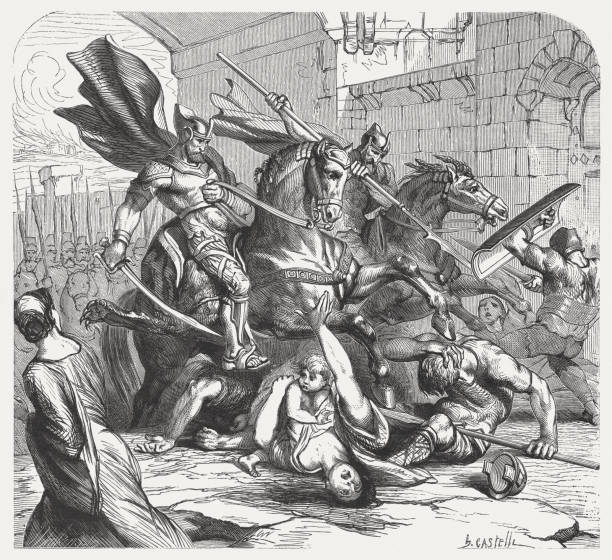
Ezekiel 28:1-19 is a prophecy against the King of Tyre. Tyre was a renowned commercial seaport located along the Great Sea, north of Galilee. It was a wealthy, glamorous, city that many merchants flocked to for trade. God Himself said that its developers had perfected its beauty. It also had a strong military which was able to defend itself from Babylonian forces for 13 years before finally subduing it (586-573 B.C).
There are not many historical records that state who the kings of Tyre were, but according to a lost list comprised by someone called Menandor of Ephesus, which the historian Josephus used in his writing entitled, Against Apion, Ithobaal III reigned Tyre from 591 to 573 B.C. The timing of his reign correlates with the timing of the Babylonian siege as well as the timing of Ezekiel's ministry (593-571 B.C.).Though Ezekiel's prophecy could be directed at any of Tyre's kings, it is likely that Ithobaal III was the recipient because he was on the throne at the time when the word of the Lord came to Ezekiel.
Tyre's Religious Beliefs
To give some background of what Tyre's religious and moral beliefs were, let's go back a couple hundred years. This might give an indication of just how wicked Tyre was.
Ithobaal I reigned as the king of Tyre and Sidon from 878-847 B.C. He was the father of Jezebel, the notorious wife of King Ahab of Israel. He was a priest of the Phoenician goddess, Astarte or Ashtoreth, who was also associated with Canaanite, Amorite, and Egyptian worship. Depending upon the region, Baal was believed to be either the son, partner, or husband of Astarte.
Astarte was the goddess of sexual love, fertility, and she had associations with war. "She is labeled the 'lady of heaven' in several second-millennium B.C.E. Egyptian texts, and in the first-millennium B.C.E. inscription of Eshmunazor, she is called 'Astarte of the highest heavens.' In Phoenician Sidon, the city most associated with the goddess’s cult, her sacred precinct is called 'highest heavens.' Phoenician sources also report Astarte’s identification with Venus, the morning and evening star." (Quoted from the Jewish Women's Archive).
When Jeremiah was prophesying against the Jews who lived in Egypt because of their idolatry, they responded that they were not going to listen to him, but they were going to continue burning incense and offering drink offerings to the queen of heaven, because when they did so, they had no trouble, but when they stopped doing so, they lacked everything they needed, and were consumed by sword and famine (Jeremiah 44:17-18). The "queen of heaven" referred to here, may have been referring to Astarte.
It seems likely that Astarte's close relationship with Baal, would have also led Tyre to worship him also. Baal was believed to be the most powerful god, even greater than his father, El, the chief god. Canaanites believed that Baal was the sun god, and the storm god, who interestingly, "Rides on the Heavens". Phoenecians called him, Baal Shamen, which means, "Lord of the Heavens".
Baal was also believed to be the god of fertility who often provided children, therefore worship of Baal was rooted in sensuality, and prostitution commonly took place within the temple. Child sacrifices were often required in order to appease him. Because Astarte was believed to be the daughter, the wife, or the partner of Baal, and worshipped as the goddess of sexual love and fertility, just as Baal was the god of fertility, it seems logical that similar heinous acts of worship would have been required by her followers.
In Josephus's citation of Menandor, he said that "the previous king, Phelles, 'was slain by Ithobalus, the priest of Astarte, who reigned thirty-two years, and lived sixty-eight years; he was succeeded by his son Badezorus (Baal-Eser II).'” "Ithobalus" referred to here, is Ithobaal I, who murdered his predecessor and became king of Tyre and Sidon. It may have been the influence of Ithobaal's worship of Astarte, and her association with war and Baal, which led to this violent act.
Ithobaal and the gods he served seemed to have influenced his daughter Jezebel, who became the wife of Ahab, the most wicked king of Israel, even outdoing his father, Omri, whom the Bible mentions as doing "worse than all who were before him" (1 Kings 16:25). With the influence of his father, his father in-law, and his wife, Ahab led Israel in serving and worshipping Baal, even making an image of him, and building a temple, setting up an altar for the false god in Samaria, the capital of Israel. God was not pleased because "Ahab did more to provoke the God of Israel to anger than all the kings of Israel who were before him ":
'Now Ahab the son of Omri did evil in the sight of the Lord , more than all who were before him. And it came to pass, as though it had been a trivial thing for him to walk in the sins of Jeroboam the son of Nebat, that he took as wife Jezebel the daughter of Ethbaal, king of the Sidonians; and he went and served Baal and worshiped him. Then he set up an altar for Baal in the temple of Baal, which he had built in Samaria. And Ahab made a wooden image. Ahab did more to provoke the God of Israel to anger than all the kings of Israel who were before him. '.
Israel's alliance with Ithobaal and the marriage between an Israelite king and a Phoenician princess and idolatress, led Israel to commit heinous sin against God. Jezebel's wicked influence on Ahab is recorded in 1 Kings 21:25:
"But there was no one like Ahab who sold himself to do wickedness in the sight of the Lord , because Jezebel his wife stirred him up" (1 Kings 21:25).
Jezebel seems to have held more authority in Israel than Ahab, and he even allowed her to have the authority over him and was in submission to her:
'Then Jezebel his wife said to him, “You now exercise authority over Israel! Arise, eat food, and let your heart be cheerful; I will give you the vineyard of Naboth the Jezreelite.” And she wrote letters in Ahab’s name, sealed them with his seal, and sent the letters to the elders and the nobles who were dwelling in the city with Naboth. She wrote in the letters, saying, Proclaim a fast, and seat Naboth with high honor among the people; and seat two men, scoundrels, before him to bear witness against him, saying, “You have blasphemed God and the king.” Then take him out, and stone him, that he may die. So the men of his city, the elders and nobles who were inhabitants of his city, did as Jezebel had sent to them, as it was written in the letters which she had sent to them ' (1 Kings 21:7-11).
Her wickedness against God's prophets is also recorded in the Bible:
'For so it was, while Jezebel massacred the prophets of the Lord , that Obadiah had taken one hundred prophets and hidden them, fifty to a cave, and had fed them with bread and water.) ' (1 Kings 18:4).
We see later in this passage that she had prophets of Baal and Asherah eating at her table:
' Now therefore, send and gather all Israel to me on Mount Carmel, the four hundred and fifty prophets of Baal, and the four hundred prophets of Asherah, who eat at Jezebel’s table.”' (1 Kings 18:19).
Asherah was one of the three goddesses of the Canaanite pantheon. The other two were Astarte and Anath.
The word of the Lord came to Elijah, to reveal His power over Baal to Israel, and after He had done so, Elijah executed all of the prophets of Baal in accordance with His word (1 Kings 18:20-40).
God's judgement eventually came upon Jezebel because of her wickedness, as well as the entire house of Ahab. Her violent death was prophesied by Elijah (1 Kings 21:23), and was later fulfilled through Jehu king of Israel, whom the Lord anointed as king, and who He instructed through Elijah to strike down Jezebel and the house of Ahab. By killing her, God avenged the death of His prophets and His servants that were done at her hand. (2 Kings 9:30-37).
Observation
An observation that I have made in this section of Ezekiel where God is dealing with these other nations besides Israel, is that He does not describe them as being "harlots", or "adulterers", as He does with Israel, even though they are steeped in the worship of evil, false gods. This is because these were pagan nations; they were not His kingdom of people nor His bride as Israel was. He did not make a covenant with them, as He had made with Israel, which He likened to a marriage covenant. The seemingly harsh, offensive language that we read of "harlotry", "adultery", "divorce", and "breaking the covenant", were directed at the kingdom of people whom He was in this marriage covenant with. Because He did not make a covenant with these other nations, when they worshipped false gods they were not committing harlotry or adultery against Him as Israel was, and therefore He did not divorce them because they broke the covenant as He did with Israel, because there was no covenant to break.
God's judgement came upon these nations because they were puffed up with pride, their kings viewed themselves as God, and they were causing harm to His people. Just as He avenged His prophets and servants who were killed by Jezebel, He avenges His prophets and servants who are harmed or killed by other nations or people.
There was a distinction between these nations and His nation, and there still is today. He does not view people who are not in the covenant with Christ the same way as He does those who are. Today, His bride are those who enter into a marriage covenant with Jesus. He would like to see everyone enter into this covenant, but He has given that assignment to His people to accomplish, which they are not doing a very good job at accomplishing. Though I do not believe that everyone will enter into His covenant because many will reject Him, there will be a time when He returns and His kingdom will fill the earth, restoring all righteousness and justice.
The King of Tyre, the King of Babylon, Satan, and Lucifer
Ezekiel 28:1-10
Christian tradition teaches that the king of Tyre in chapter 28 of Ezekiel is actually referring to Satan. This is one of the only passages in the Bible that is believed to give us a glimpse of the evil one's origin. The other one is Isaiah 14:12-15 which tradition teaches is the fall of Lucifer from heaven. Though this idea may be true, I tend to think that these passages are about the king of Tyre and the king of Babylon, which are whom the Bible says they are about. But I will take the time here to describe where this theory comes from, and give my reasons why it seems a more likely scenario that they are not about Satan, but about the kings of Tyre and Babylon.
The idea that the king of Tyre in Ezekiel 28 is referring to Satan comes from a few verses within the chapter which I will do my best to explain below.
To begin with, the context of both of these passages are about earthly kings - the king of Tyre, and the king of Babylon. However, the scenario goes, as the prophets are describing God's judgement of these kings, He allegedly varies off topic and begins describing Satan. This seems unlikely, but it is what Christian tradition has taught since the early church father Tertullian introduced the idea.
In the passage, the word of the Lord came to Ezekiel in verse 2 and instructed Ezekiel to prophesy to the "prince" of Tyre, and in verse 12 He instructed him to raise a lamentation over the "king" of Tyre. Because verse 1 uses the word "prince" and verse 12 uses the word "king" it is believed that God is addressing two different characters, referring to the king of Tyre as the "prince" and Satan as the "king". In this scenario, Satan is the power behind the king; he is a type of Antichrist.
However, it is not unreasonable for the prince and the king to be the same person - that person being the king of Tyre. We have seen several times throughout Ezekiel, where God refers to the kings of Judah as "princes" (Ezekiel 19:1; 21:12; 22:6; 22:27; 45:8-9).
Then, back in chapter 26, we see where God said that all the "princes" of the sea would step down from their thrones and remove their robes and strip off their embroidered garments (Ezekiel 26:16). Kings are usually depicted as sitting on thrones and wearing robes. Isaiah described God this way in his vision when he was called to be a prophet. He said:
"In the year that King Uzziah died, I saw the Lord sitting on a throne, high and lifted up, and the train of His robe filled the temple" (Isaiah 6:1).
In John's vision, he saw Jesus and said,
"And He has on His robe and on His thigh a name written: KING OF KINGS AND LORD OF LORDS" (Revelation 19:16).
Isaiah prophesying against Assyria said,
[8] For he says, ‘Are not my princes altogether kings?' (Isaiah 10:8)
Based on what these scriptures say about kings, is God referring to princes in Ezekiel 26:16, or to kings? It seems evident by comparing what other scriptures say, that He is referring to kings, even though He called them "princes". So, if He referred to these kings as "princes" in Ezekiel 26:16, as well as in other passages of scripture, then there is no reason to assume that when He refers to the king of Tyre as both a prince and a king, that he is speaking about two different characters.
Next, Ezekiel 28:2-5 allegedly describes Satan's pride which leads to him being cast out of God's presence:
[2] “Son of man, say to the prince of Tyre, ‘Thus says the Lord God: “Because your heart is lifted up, And you say, ‘I am a god, I sit in the seat of gods, In the midst of the seas,’ Yet you are a man, and not a god, Though you set your heart as the heart of a god [3] (Behold, you are wiser than Daniel! There is no secret that can be hidden from you! [4] With your wisdom and your understanding You have gained riches for yourself, And gathered gold and silver into your treasuries; [5] By your great wisdom in trade you have increased your riches, And your heart is lifted up because of your riches)” (Ezekiel 28:2-5).
Based on the description of the prince of Tyre, there is no doubt that he was prideful and viewed himself as a god. He also viewed himself as being exceedingly wise, so wise in fact that God sarcastically says, "you are wiser than Daniel! No secret can be hidden from you!" However, implying that this is referring to Satan is stretching it, because there is no indication that it is referring to Satan. Many kings, including Nebuchadnezzar of Babylon and the Pharaohs of Egypt, were filled with pride and viewed themselves as gods. Remember in Daniel when Shadrach, Meshach, and Abednego were thrown into the fiery furnace because they refused to bow down and worship the statue of Nebuchadnezzar? Nebuchadnezzar's boastful pride is also seen when he said that Babylon was built by his mighty power and for the honor of his majesty, a declaration that he was a god:
[30] The king spoke, saying, “Is not this great Babylon, that I have built for a royal dwelling by my mighty power and for the honor of my majesty?” (Daniel 4:30).
Alexander the Great, who eventually conquered Tyre, deified himself by identifying as Hercacles, the son of the Greek god Zeus, as well as with Dionysus, the Greek god of wine and ecstasy.
Today, leaders of countries such as North Korea view themselves as gods and require their subjects to worship them.
It is not unusual that the king of Tyre viewed himself as being a god, because many kings did, and still do. However as God said to him, "You are a man and not a god, though you set your heart as the heart of a god." God makes it clear that He is talking to a very prideful man and not to one of His angels, or more specifically, to Satan.
Though the king of Tyre was evil and had Satanic practices, and therefore Satan did have control of him in that regard, there is no evidence here that indicates that this passage is speaking about him being a type of Antichrist or Satan. However, we are not done yet.
Ezekiel 28:11-17
Even more-so than the previous passages, Ezekiel 28:11-17 has been used to help develop this scenario that Satan was an angel who exalted himself above God, and therefore God cast him out of His presence. The question is, is that what the passage says? Let's take a look:
[11] Moreover the word of the Lord came to me, saying, [12] “Son of man, take up a lamentation for the king of Tyre, and say to him, ‘Thus says the Lord God: “You were the seal of perfection, Full of wisdom and perfect in beauty. [13] You were in Eden, the garden of God; Every precious stone was your covering: The sardius, topaz, and diamond, Beryl, onyx, and jasper, Sapphire, turquoise, and emerald with gold. The workmanship of your timbrels and pipes Was prepared for you on the day you were created. [14] “You were the anointed cherub who covers; I established you; You were on the holy mountain of God; You walked back and forth in the midst of fiery stones. [15] You were perfect in your ways from the day you were created, Till iniquity was found in you. [16] “By the abundance of your trading You became filled with violence within, And you sinned; Therefore I cast you as a profane thing Out of the mountain of God; And I destroyed you, O covering cherub, From the midst of the fiery stones. [17] “Your heart was lifted up because of your beauty; You corrupted your wisdom for the sake of your splendor; I cast you to the ground, I laid you before kings, That they might gaze at you. [18] “You defiled your sanctuaries By the multitude of your iniquities, By the iniquity of your trading; Therefore I brought fire from your midst; It devoured you, And I turned you to ashes upon the earth In the sight of all who saw you. [19] All who knew you among the peoples are astonished at you; You have become a horror, And shall be no more forever.” ’ ” (Ezekiel 28:11-19).
Here in verse 12, God instructed Ezekiel to say to the "king of Tyre ", who is allegedly Satan, "you were the seal of perfection, full of wisdom and beauty", and in verse 15, "you were perfect in your ways", and in verse 17, "your heart was lifted up because of your beauty; you corrupted your wisdom for the sake of your splendor." It's in these verses that the idea was concocted that Satan was the wisest, most beautiful being that God created, and because of his perfect beauty and immense wisdom, he became prideful and turned on God. In return, God cast him out of heaven.
But looking back at the previous chapter, God said through Ezekiel that He had heard the city of Tyre pridefully say, "I am perfect in beauty", and then God said, "Your builders have perfected your beauty" (Ezekiel 27:3-4). Could it be possible that it is not Satan who is saying in Ezekiel 28:12 that he is perfect in beauty, but that it was the king of Tyre who said it, speaking of his kingdom, simply reiterating what he already said in 27:3? I think it's not only possible, but probable.
The idea that the king of Tyre was Satan, and that Satan was an angel, is derived from verses 13, and 14 where it says that "he was in Eden, the garden of God", and "you were the anointed cherub who covers...you were on the holy mountain of God."
Christian tradition teaches that because Satan was in the garden of Eden in the form of a serpent, the king of Tyre is actually Satan because the literal king of Tyre was certainly not in Eden. Only God, Adam, Eve, and Satan were there, and all except for God and Satan would have been long dead by Ezekiel's time, therefore it has to be Satan because we know it is not God.
However, in Ezekiel 31, the nation of Assyria is likened to a strong cedar tree in the "garden of God" (Eden) (Ezekiel 31:3, 8-9). This is very similar to Ezekiel 28:13 which says that the king of Tyre was in the garden of Eden. It seems to be known and understood by scholars that Assyria was not an actual tree, and that it was not literally located within the garden of Eden. If Assyria was not an actual tree within the garden of Eden, then why must it be necessary to believe that the king of Tyre was literally in the garden of Eden, and therefore must be Satan? The answer is, it's not. This verse, as well as the one about Assyria, possibly means that Tyre and its king had everything going for them - power, wealth, notoriety, etc. He was in "heaven", "paradise" (the "garden of God"). If we are on vacation in Hawaii, we might say, "we are in paradise", or "this is heaven." That is likely what God meant when He said that the king of Tyre was in the garden of Eden.
The reasoning goes on to say that cherub are angelic beings, and therefore Satan was an angel, but not only an angel, but the most powerful archangel. He was also with God on His holy mountain, which indicates that he was once close to God and had favor with Him.
Christian tradition teaches that Satan was an archangel based on one verse that is believed to support this idea. However, this verse contains the word "cherub" to describe the alleged Satan, not "archangel." To get around this problem, some teach that Satan was both an archangel and an "anointed cherubim" who was placed in the garden of God to enlighten human souls and bring the glory of God to everyone. No doubt this idea comes from the cherubim whom God placed in the garden of Eden to guard the way to the tree of life after Adam and Eve were exiled.
The question is, does the Bible actually teach that Satan was either an archangel, a cherub, or both, as tradition teaches?
Since the one verse that is used to develop this scenario uses the word "cherub", a good question to consider is, according to what the Bible says, are cherubim and archangels the same beings created for the same purpose? To answer this question, let's look at what the Bible has to say about each of them.
Ezekiel provides the only complete physical description of a cherub in the Bible. These can be found in Ezekiel 1:5-25, and Ezekiel 10:
[5] "Also from within it came the likeness of four living creatures. And this was their appearance: they had the likeness of a man. [6] Each one had four faces, and each one had four wings. [7] Their legs were straight, and the soles of their feet were like the soles of calves’ feet. They sparkled like the color of burnished bronze. [8] The hands of a man were under their wings on their four sides; and each of the four had faces and wings.
[10] "As for the likeness of their faces, each had the face of a man; each of the four had the face of a lion on the right side, each of the four had the face of an ox on the left side, and each of the four had the face of an eagle. [11] Thus were their faces. Their wings stretched upward; two wings of each one touched one another, and two covered their bodies.
[13] "As for the likeness of the living creatures, their appearance was like burning coals of fire, like the appearance of torches going back and forth among the living creatures. The fire was bright, and out of the fire went lightning" (Ezekiel 1:5-8).
There are other mentions and less detailed descriptions of cherub in other passages such as Exodus 25:18-22, Exodus 37:7-9, I Kings 6:22-28, II Chronicles 3:10-13, Psalm 18:10, Ezekiel 41:18-20, and Genesis 3:24.
In these passages, cherub are described as spiritual guardians. God instructed Moses to inscribe cherubim at each end of the mercy seat that was set above the arc of the covenant, and their wings were to cover the mercy seat. It was here, above the mercy seat, and between the cherubim that God gave Moses His commandments to Israel, and it was inside the arc of the covenant where he was commanded to put them (Exodus 25:18-22). The inscribed cherubim were guardians of the Testimony.
When building the temple, King Solomon prepared the inner sanctuary to place the arc of the covenant. He carved cherubim inside the inner sanctuary and on its doors, as well as on the walls of the inner and outer sanctuaries. Again, the purpose of the carved cherubim were to guard the arc of the covenant where the Testimony was kept (1 Kings 6:19-35).
In the temple that is described in Ezekiel 41, cherubim were to be carved on the doors and walls, probably as guardians of the temple (Ezekiel 41:18-25).
In Ezekiel's vision, the cherubim were below the throne of the "likeness of the glory of the Lord." They were positioned as guardians between the earth and God's throne in heaven (Ezekiel 1:5-25).
When God's presence left the temple in Ezekiel 10, the cherubim are positioned above the temple, and below God, and are seen by Ezekiel leaving the temple and the earth. They were positioned as guardians between the temple and God (Ezekiel 10).
After Adam and Eve sinned, God cast them out of the Garden of Eden and placed cherubim to guard the way to the tree of life (Genesis 3:25).
Based on the passages found in the Bible about cherub, it seems evident that they were created as guardians. It is also evident that no passages in the Bible indicate that Satan was a cherub, and the one verse where this idea is derived from is said to be about the king of Tyre.
As for the idea that Satan was the anointed cherub in the garden of God to enlighten human souls and bring the glory of God to everyone, the Bible no where supports it either. First, there were only two people in the garden of God, and they were both cast out. There were no other souls to enlighten. Furthermore, the cherubim were placed there to guard the way to the tree of life, not to enlighten human souls or bring the glory of God to everyone. Unfortunately those who believe this have absolutely no Biblical basis for doing so.
Now let's look at what the Bible says about archangels:
[9] Yet Michael the archangel, in contending with the devil, when he disputed about the body of Moses, dared not bring against him a reviling accusation, but said, “The Lord rebuke you!” (Jude 1:9)
[16] For the Lord Himself will descend from heaven with a shout, with the voice of an archangel, and with the trumpet of God. And the dead in Christ will rise first (I Thessalonians 4:16).
The above verses are the only two in the Bible that use the word "archangel", and Satan is not mentioned in either of them. In fact, they do not give us much information at all. However, we are able to derive additional information about archangels from learning more about what the Bible says about Michael, the only archangel who is mentioned in the Bible. (Note: The fact that Michael is the only archangel mentioned in the Bible poses another problem that Christian tradition teaches, and that is that there are anywhere from three to seven archangels. But we will not look at that now.)
[9] Yet Michael the archangel, in contending with the devil, when he disputed about the body of Moses, dared not bring against him a reviling accusation, but said, “The Lord rebuke you!” (Jude 1:9)
[13] "But the prince of the kingdom of Persia withstood me twenty-one days; and behold, Michael, one of the chief princes, came to help me, for I had been left alone there with the kings of Persia" (Daniel 10:13).
[1] “At that time Michael shall stand up, The great prince who stands watch over the sons of your people; And there shall be a time of trouble, Such as never was since there was a nation, Even to that time. And at that time your people shall be delivered, Every one who is found written in the book" (Daniel 12:1).
[7] And war broke out in heaven: Michael and his angels fought with the dragon; and the dragon and his angels fought, [8] but they did not prevail, nor was a place found for them in heaven any longer. [9] So the great dragon was cast out, that serpent of old, called the Devil and Satan, who deceives the whole world; he was cast to the earth, and his angels were cast out with him" (Revelation 12:7-9).
In the above passages, we can see that Michael the archangel:
- contended with the devil when he disputed about the body of Moses;
- was a "chief prince" who helped the "man clothed in linen" presumably fight against the prince of Persia;
- was the "great prince" who stood watch over Israel;
- fought against the devil and his angels, casting them out of heaven to earth.
We can also see that the role of an archangel is somewhat different than that of a cherub. It is true that Michael stood watch over Israel, possibly as a guardian, but from the descriptions of cherubim given throughout the Bible, they do not engage in battle as Michael does. However, Michael could be viewed as both a cherub and an archangel, and therefore this could be where the idea that Satan was both a cherub and an archangel comes from.
But the problem is that none of these passages indicate that Satan was an archangel or a cherub. Apparently, he has angels fighting for him, but he himself is not said to have been one.
Some Christians who believe that there was a gap period between the earth's creation, and the creation of man, teach that the earth was covered with precious stones and jewels, and that the serpent Satan lived among them, just as a snake lives under a rock. This idea comes from verses 13 and 14:
"Every precious stone was your covering: The sardius, topaz, and diamond, Beryl, onyx, and jasper, Sapphire, turquoise, and emerald with gold" (Ezekiel 28:13).
"You walked back and forth in the midst of fiery stones" (Ezekiel 28:14).
This idea is merely speculation based on the theory that Satan reigned and inhabited the earth prior to man being created. There is no Biblical support for it.
What it likely means is that the king of Tyre, being a king, had all kinds of precious jewels and gem stones which he adorned himself with, as kings do.
Another idea that is derived from this passage is that God created Satan with musical instruments that were attached to his body, and because of this, he led the worship in heaven before being cast out. It is said that he was created to be musically inclined, so after God cast him out of heaven, he began using music to deceive people and lead them into evil. All of this comes from one verse in the King James Version of the Bible which is found in Ezekiel 28:13:
"the workmanship of thy tabrets and of thy pipes was prepared in thee in the day that thou wast created" (Ezekiel 28:13).
The New King James Version translates it this way:
"The workmanship of your timbrels and pipes Was prepared for you on the day you were created" (Ezekiel 28:13).
"Tabret" is plural for "tabor". A tabor and a timbrel are a small drum or tambourine (without jingles), especially one intended to be used by a piper while playing his pipe. Based on this translation, the verse would be about musical instruments. However, most modern day translations translate "timbrels and pipes" not as musical instruments, but as jewel settings and mountings, or similar, which fits the context of the previous part of the verse better. Let's look at a few different translations:
'You were in Eden, the garden of God; every precious stone was your covering, sardius, topaz, and diamond, beryl, onyx, and jasper, sapphire, emerald, and carbuncle; and crafted in gold were your settings and your engravings. On the day that you were created they were prepared.' (Ezekiel 28:13 ESV).
'You were in Eden, the garden of God; every precious stone adorned you: carnelian, chrysolite and emerald, topaz, onyx and jasper, lapis lazuli, turquoise and beryl. Your settings and mountings were made of gold; on the day you were created they were prepared. ' (Ezekiel 28:13 NIV).
'You were in Eden, the garden of God; Every precious stone was your covering: The ruby, the topaz and the diamond; The beryl, the onyx and the jasper; The lapis lazuli, the turquoise and the emerald; And the gold, the workmanship of your settings and sockets, Was in you. On the day that you were created They were prepared. ' (Ezekiel 28:13 NASB).
' You were in Eden, the garden of God. Every precious stone was your covering, the ruby, topaz, and emerald, the chrysolite, onyx, and jasper, the sapphire, turquoise, and beryl; your settings and mounts were made of gold. On the day you were created they were prepared.' (Ezekiel 28:13 NET).
These translations totally change the meaning of the passage from referring to music, to referring to jewels, stones and gems, totally eliminating the ridiculous notion that Satan is described here as being created with musical instruments attached to his body, and being the worship leader in heaven. As stated above, the passage is more likely to mean that the king of Tyre was adorned in jewels and gems, and that "settings and sockets/mounts" refer to the attachment of the jewel or gem, such as an engagement ring setting.
Verses 15-19 allegedly describes how the perfect, beautiful, and wise archangel Satan turns away from God and turns to evil, and therefore God cast Him out of heaven to the earth:
[15] "You were perfect in your ways from the day you were created, Till iniquity was found in you. [16] “By the abundance of your trading You became filled with violence within, And you sinned; Therefore I cast you as a profane thing Out of the mountain of God; And I destroyed you, O covering cherub, From the midst of the fiery stones. [17] “Your heart was lifted up because of your beauty; You corrupted your wisdom for the sake of your splendor; I cast you to the ground, I laid you before kings, That they might gaze at you. [18] “You defiled your sanctuaries By the multitude of your iniquities, By the iniquity of your trading; Therefore I brought fire from your midst; It devoured you, And I turned you to ashes upon the earth In the sight of all who saw you. [19] All who knew you among the peoples are astonished at you; You have become a horror, And shall be no more forever" (Ezekiel 28:15-19).
Though this is thought to be about Satan being cast out of heaven because of his pride, it seems to be describing the literal king of Tyre. It was by the abundance of his trading that he became filled with violence and sinned. Tyre was a commercial seaport and trading and merchandising was central to its industry. Tyre's trading led to its wickedness as riches and wealth often do. Because of his wickedness, he became a horror to the surrounding cities, and God was going to destroy him.
"I cast you as a profane thing out of the mountain of God; and I destroyed you, o covering cherub, from the midst of your fiery stones"
The language sounds as if God is casting a cherub out of His mountain. But similar to how we say that we go through peaks and valleys, and that we are on a mountain-top when things are going good for us, God had set the king of Tyre on a mountain. However, he viewed and exalted himself as a god, even though he was an ordinary man and not a god (vs.9). He became wicked and therefore God cast him out of his mountain, meaning that He brought him low; he would no longer be riding the mountain top, but he would go down into the valley.
Because he was the king, the king of Tyre was the guardian of the city, therefore God described him as a covering cherub. God destroyed him from among his "fiery stones", which may refer to his riches and wealth being burned with the fire which devoured him and turned him to ashes (vs.18).
One other problem to mention regarding this passage, is that it does not make sense to many people that Satan would have thought that he was greater than God and could overcome Him, because if he was the wisest being in creation, and he dwelt with God in His presence, then how could he ever think such a thing? If he was so wise, and he saw God all the time and knew Him personally, then it seems that he would have known that he could not compare to God.
This sums up everything in Ezekiel 28 that Christian tradition uses to teach the origin Satan. However, there is no reason whatsoever to assume that it is talking about anyone but the king of Tyre. To answer the question at the beginning of this section, the passage nowhere indicates that it is about Satan.
Lucifer
Isaiah 14:12-21 is also believed to support the idea of Satan being cast out of heaven by God, however in this passage, the character who is believed to be Satan is referred to as Lucifer. In addition to the question of whether this passage is actually referring to Satan or not, we also have to assess if Lucifer and Satan are in fact, one in the same being. Let's read the passage to see what it says:
[12] “How you are fallen from heaven, O Lucifer, son of the morning! How you are cut down to the ground, You who weakened the nations! [13] For you have said in your heart: ‘I will ascend into heaven, I will exalt my throne above the stars of God; I will also sit on the mount of the congregation On the farthest sides of the north; [14] I will ascend above the heights of the clouds, I will be like the Most High.’ [15] Yet you shall be brought down to Sheol, To the lowest depths of the Pit. [16] “Those who see you will gaze at you, And consider you, saying: ‘Is this the man who made the earth tremble, Who shook kingdoms, [17] Who made the world as a wilderness And destroyed its cities, Who did not open the house of his prisoners?’ [18] “All the kings of the nations, All of them, sleep in glory, Everyone in his own house; [19] But you are cast out of your grave Like an abominable branch, Like the garment of those who are slain, Thrust through with a sword, Who go down to the stones of the pit, Like a corpse trodden underfoot. [20] You will not be joined with them in burial, Because you have destroyed your land And slain your people. The brood of evildoers shall never be named. [21] Prepare slaughter for his children Because of the iniquity of their fathers, Lest they rise up and possess the land, And fill the face of the world with cities.” (Isaiah 14:12-21).
At first glance, we see that someone named Lucifer wanted to exalt himself above the heavens and become like God, therefore God said that he will be brought to Sheol, the lowest depths of the pit (sheol is translated "hell" in the King James Version). So the obvious question is, who was or is Lucifer?
Today, when we hear the name Lucifer, we immediately think that it is the same being as Satan. This is again because of what Christian tradition teaches. But, is what Christian tradition teaches about this subject, Biblically accurate?
When Jerome translated the Bible from Hebrew to Latin, he translated "heilel" to "lucifer", both with similar meanings of "bringer of dawn", "morning star", "the planet Venus", or "light bringing". Just a side note, but remember reading about the goddess Astarte when we were looking at Tyre's religious background earlier in this article? She identified with Venus, the morning and evening star, and her "precinct was in the highest heavens." Based on this information, she also could have been called "lucifer."
When King James translated the Bible to English, he failed to translate "lucifer" from Latin to English, and he capitalized the letter "L" in "Lucifer", making it appear as a proper noun, or the name of an individual. The verse should read something like, "How you are fallen from heaven, morning star (Venus), son of the dawn." Sorry King James only Christians, but this is another problem found in the King James and New King James Version translations. Other modern translations are more accurate. Below are a few examples:
'How you have fallen from heaven, O star of the morning, son of the dawn! You have been cut down to the earth, You who have weakened the nations! ' (Isaiah 14:12 NASB).
'“How you are fallen from heaven, O shining star, son of the morning! You have been thrown down to the earth, you who destroyed the nations of the world. ' (Isaiah 14:12 NLT).
'How you have fallen from heaven, morning star, son of the dawn! You have been cast down to the earth, you who once laid low the nations! ' (Isaiah 14:12 NIV).
'“How you are fallen from heaven, O Day Star, son of Dawn! How you are cut down to the ground, you who laid the nations low! ' (Isaiah 14:12 ESV).
Now knowing that "Lucifer" was not translated to English from Latin, and that it is not the proper name of an individual, we can try to figure out if the verse is referring to Satan or to somebody else. Who is this "star, son of the dawn" who has fallen from heaven? Well, that is easy enough to find out. Let's look at the context of the passage:
In verse 4, God said to Israel, that when He has given them rest, they were to take up a taunt against the king of Babylon, and later in verse 22, God said that He will rise up against Babylon and cut off name, remnant, descendants, and posterity from her:
[3]'When the Lord has given you rest from your pain and turmoil and the hard service with which you were made to serve, [4] you will take up this taunt against the king of Babylon: “How the oppressor has ceased, the insolent fury ceased!' (Isaiah 14:3-4).
'“I will rise up against them,” declares the Lord of hosts, “and will cut off from Babylon name and remnant, descendants and posterity,” declares the LORD. ' (Isaiah 14:22).
Christian tradition teaches that the passage begins and finishes with God speaking about the king of Babylon, but in the middle He turns His attention to Satan, describing his origin. However there is nothing in the passage that indicates that He did so. The entire passage is about the king of Babylon. The Lexham Bible Dictionary says under the definition of "Lucifer": "(Latin derivation of heilel). The morning star; an epithet of Venus. A title given to the king of Babylon. The early church fathers began to apply the term to Satan, possibly due to the belief that he had fallen from heaven (Luke 10:18)."
Look at what Daniel said to King Belshazzar about King Nebuchadnezzar:
18 O king, the Most High God gave Nebuchadnezzar your father a kingdom and majesty, glory and honor. 19 And because of the majesty that He gave him, all peoples, nations, and languages trembled and feared before him. Whomever he wished, he executed; whomever he wished, he kept alive; whomever he wished, he set up; and whomever he wished, he put down. 20 But when his heart was lifted up, and his spirit was hardened in pride, he was deposed from his kingly throne, and they took his glory from him. 21 Then he was driven from the sons of men, his heart was made like the beasts, and his dwelling was with the wild donkeys. They fed him with grass like oxen, and his body was wet with the dew of heaven, till he knew that the Most High God rules in the kingdom of men, and appoints over it whomever He chooses" (Daniel 5:18–21).
When compared side by side, Isaiah 14:12-21 and Daniel 5:18-21 are very similar. It seems evident that Isaiah is not talking about Satan but about the King of Babylon.
The Tower of Babel
Genesis 11:4 is another passage to consider when trying to determine if Isaiah 14 is referring to an evil angel of God being cast out of heaven, or a king and his country falling from power:
[4] And they said, “Come, let us build ourselves a city, and a tower whose top is in the heavens; let us make a name for ourselves, lest we be scattered abroad over the face of the whole earth" (Genesis 11:4).
These men wanted to make a name for themselves, therefore, working together they built themselves a city and a tower so that they could ascend into heaven by their own power, and exalt themselves as gods. Interestingly, the city of Babel and the city of Babylon are one in the same. "Babel" is the transliteration of the Hebrew word "Ba-bel", and "Babylon" is the Greek translation.
The Babylonian's desire to exalt themselves to God status in Genesis 11:4 is very similar to what "Lucifer" said in Isaiah 14:13-14:
[13] "I will ascend into heaven, I will exalt my throne above the stars of God; I will also sit on the mount of the congregation On the farthest sides of the north; [14] I will ascend above the heights of the clouds" (Isaiah 14:13-14).
The Babylonians of Genesis, as well as the Babylonians of Isaiah, had viewed themselves as gods and their kingdoms as heaven. Nebuchadnezzar pridefully said:
[30] “Is not this great Babylon, that I have built for a royal dwelling by my mighty power and for the honor of my majesty?” (Daniel 4:30).
Furthermore, Nebuchadnezzar attempted to kill Daniel's companions because they refused to bow to his image (Daniel 3).
King Darius threw Daniel into the lions den because he prayed to God instead of to him (Daniel 6).
The point is, it is not unreasonable that Isaiah 14 is about the fall of the King of Babylon and not about Satan. In fact it fits better within the context of the passage as well as other passages in the Bible. God brings low those who exalt themselves, just as He did to the King of Tyre and to the King of Babylon.
Conclusion
Though it is possible that these passages are referring to Satan, it is doubtful based on what the Bible actually says. Christian tradition once again proves itself to be Biblically inaccurate. Unfortunately, most Christians have not heard this view before, and most of those who have, will continue to support the traditional view, refusing to believe what the Bible actually says. This is problematic because the truth of what the Bible really says is often ignored in order to hold to unbiblical traditions instead. Unfortunately, the religion of Christianity is full of unbiblical traditions which God did not implement, but man did. When Jesus came to Judea, He was not pleased with their religion or their religious practices, and God judged them for it by destroying the temple so that they could no longer partake in it. There are many things about the religion of Christianity that God is probably not pleased with and will judge, just as He did the Judaism. The teachings of unbiblical traditions may be one of them.
In the grand scheme of things, does it really matter if these passages are about Satan or not? On one hand, the answer is no, how Satan originated does not affect our salvation whatsoever. But on the other hand, it does matter if we are making making disciples and teaching them what the Bible says. We want to provide accurate teaching about God, and not misinformation. When teaching about God and His word, nothing is more important.
Even if we are allowing the Holy Spirit to teach them, if we are interjecting our own opinion of what a passage means, they will likely believe what we have to say because we are "experienced" Christians who "know" the Bible. This is multiplied tenfold if they hear it from a pastor, because in their eyes, the pastor is the professional Bible scholar because he went to college for Biblical studies, and therefore he knows everything there is to know about God and the Bible.
However, this is where it becomes important to allow the Holy Spirit to teach what God's word says, and not rely solely on your pastor or anyone else. Some pastors and teachers have been given the gift of teaching, so we can learn through them by the Holy Spirit. But just because someone preaches from a pulpit on Sunday morning or went to college to get a degree in Biblical studies, does not automatically make them a pastor in the Biblical sense of the word, or a Bible teacher. Therefore, we must depend on God to teach us His word Himself, as well as those whom He gas gifted to teach.
Going back to the fact that most Christians will side with tradition and the popular view over the Bible, consider that one would likely never come to the conclusion on their own that Ezekiel 28 and Isaiah 14 are about Satan. I have read them many times and never came to that conclusion. Christians believe that this is what the passages are about only because they are taught the doctrine by their pastor who was taught the doctrine by their seminary professors, who were taught the doctrine by their seminary professors, etc., etc. Certain brands of seminaries teach certain brands of doctrine, many which are rooted in Christian traditions that go back to the early church fathers. But just because they may have been taught by the early church fathers does not necessarily mean that they are correct. The early church fathers were not inspired by God as the writers of the Bible were. Therefore, I will take what the Bible says over what the early church fathers said, and over what the seminaries whose foundations are built on their teachings say. I'm not saying they are all wrong and that I will never take their teachings into consideration, but they were not 100% correct about everything they taught, and we should take that into consideration when looking at their teachings. We should always take God's word over man's.
If I am teaching Bible to someone, I want to make sure that what I am teaching them is Biblically accurate, even if does not agree with tradition or the popular view. I would rather be on the right side of God teaching the truth of His word, than teaching tradition or other's opinions which may be unbiblical.
I learned from a good Bible teacher that indoctrination is teaching only one view when more than one view exists, and then teaching that view as if it is the absolute truth. Furthermore, whoever disagrees with that view is not a true Christian and/or is going to hell. To avoid indoctrination, a good Bible teacher will present all of the views and allow each student to draw their own conclusion on which view may be correct. This calls for the student's dependence upon the Holy Spirit to teach them which view is correct and what the truth is.
This is a good method to use, but in Christianity today, too many people believe that we are saved based on our doctrinal beliefs, rather than by our faith and following Jesus. Therefore many are fearful of allowing people to hear the other views, and some will not fellowship with Christians who do not hold their doctrinal views. Most Christians will reject Biblical evidence and truth if it does not align with their own view, which could be tied to unbiblical tradition or ideologies. They would rather believe that the knowledge they possess is correct, than consider that they might actually be wrong. In doing so they often divide Christ's body, which we are supposed to be preparing for His return. There is something terribly wrong with this picture.
There is a need for a teachable spirit among the body of Christ, which currently does not exist, or at least very few currently possess. I'm not saying that a Christian will not be taught by their pastor or favorite celebrity Bible teachers, because they will listen to them no problem. I'm talking about being taught by the Holy Spirit, either directly or through Bible teachers, some of whom may not be on television, the radio, or YouTube, and may not have the outgoing personality of those who are. They might be sitting quietly in your congregation or in your Bible study. You might disagree with them on different topics, but if you listen to them and to the Holy Spirit, you might find that you are the one who is wrong. Let's have a teachable spirit, with dependence upon the Spirit, so that we can become more united and help prepare for Christ's return.